Physics
Q31. If a coil of wire having \(N\) turns is placed in a uniform time-varying magnetic field \(B,\) and the area of the coil is \(A,\) then an emf is induced in the coil:
Q32.
Heat energy is supplied at a constant rate to two substances, \(P\) and \(Q,\) which have equal masses. The variation of temperature \((T)\) with time \((t)\) for each substance is shown in the figure.
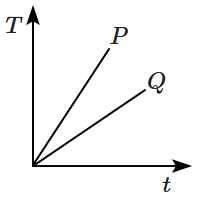
Which of the following statements is correct?
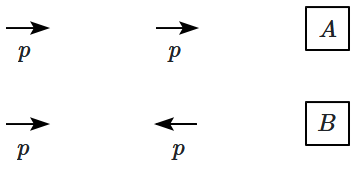
Q33. Two dipoles are placed along the \(x\)-axis, as shown in the figure, in two different configurations: \(A\) and \(B.\) Then, they will:


Q34. A gas in a vessel is initially at pressure \(P.\) If the mass of all the gas molecules is halved and their speed is doubled, then the resultant pressure will be:
Q35. Two charges, \(q_1=1.1 \times10^{-8}~\text{C}\) and \(q_2=1.1\times 10^{-9}~\text{C}\) are initially placed \(0.1~\text{m}\) apart. How much energy is required to bring them to a distance of \(0.01~\text{m}\) apart?
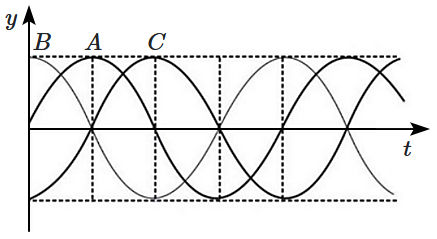
Q36. Three progressive waves \(A,\) \(B\) and \(C\) are shown below. With respect to wave \(A\text{:}\)
Q37. The surface tension of soapy water is \(S.\) When bubbles are blown with soapy water, one bubble of radius \(r\) is formed within another of radius \(3r.\) The excess pressure within the smaller bubble, relative to the atmospheric pressure is:
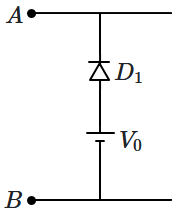
Q38. Under what conditions will diode \(D_1\) conduct?
Q39. Ultraviolet photons, each of energy \(20~\text{eV},\) are incident onto a gas of \(\mathrm {H}\)-atoms, causing the emission of electrons. The kinetic energy of the emitted electrons has the value:
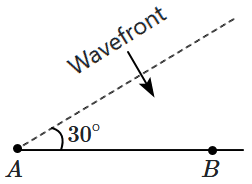
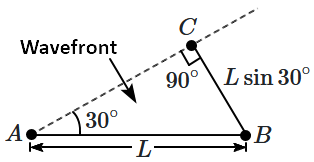
Q40. A plane electromagnetic wavefront is incident at an angle of \(30^{\circ}\) onto a flat surface. The difference between the arrival times of the wave at the points \(A\) and \(B\) is \(T,\) where \(AB=L.\) Then, the speed of the wavefront in the medium is: