
Physics
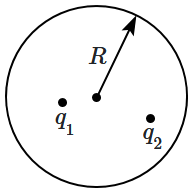
Q41. An uncharged spherical conducting shell of outer radius \(R\) has two point charges \(q_1,q_2\) placed within it. The flux of the electric field due to all charges from the outer surface of the sphere is \(\phi_0\) while the potential of the sphere is \(V_0.\) The ratio \(\dfrac{\phi_0}{V_0}\) is proportional to:
Q42. An object placed in front of a concave mirror of a focal length \(15~\text{cm}\) produces a virtual image which is twice the size of the object. The position of the object is:
Q43. An electromagnetic waveform which has an electric field given by:
\(\vec{E}=E_{0}[\hat{\imath} \cos (\omega t-k z)+\hat{\jmath} \cos (\omega t-k x)]\) and the waveform propagates. The maximum electric field has the magnitude:
\(\vec{E}=E_{0}[\hat{\imath} \cos (\omega t-k z)+\hat{\jmath} \cos (\omega t-k x)]\) and the waveform propagates. The maximum electric field has the magnitude:
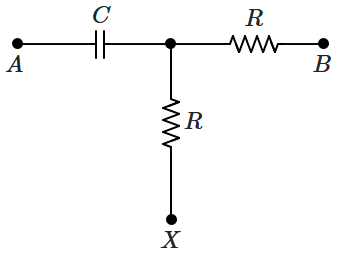
Q44. The end \(‘B’\) of the circuit is earthed \((V_B = 0)\) while a sinusoidal voltage is applied at \(‘A’;\) \(V_{A}=V_{0} \sin \omega t.\) The rms voltage across the capacitor \({C}\) equals that across the upper resistor \({R}\) (as shown in the figure). What is the phase difference between the current through the capacitor and the voltage across the capacitor when no current flows out at \(X?\)
Q45. Dispersion of light is caused due to:
Q46. A charged particle (of mass \(m\) and charge \(q\)) is projected from large distance towards another identical charge with speed \(v.\) Potential energy of the system of the charges, at the instant of minimum separation, is:
Q47. The kinetic energy \(K\) for a particle executing simple harmonic motion is given by; \(K = K_0 \sin^2(\omega t).\) The maximum value of potential energy is:
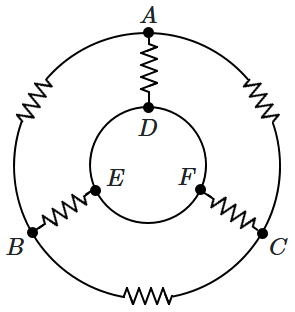
Q48. All the resistances shown in the network are equal to \(1~\Omega.\) Find the resistance of the network measured between \(A\) and \(D.\)

Q49. A step-down transformer connected to an AC mains supply of \(220~\text{V}\) is made to operate at \(11~\text{V},\) \(44~\text{W}\) lamp. Ignoring power losses in the transformer, what is the current in the primary circuit?
Q50. \(\overrightarrow {A}\) is a vector with magnitude \(A\), then the unit vector \(\hat{A}\)