
Alcohols,Phenols and Ethers
Q1. The enzymes involved in the preparation of ethanol from sucrose by fermentation are:
Q2.
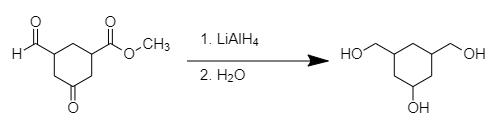
Predict the product when the given compound reacts with LiAlH4 :


Q3. Reagents that can be used to convert alcohols to carboxylic acids are:
(A) CrO3 – H2SO4
(B) K2Cr2O7 + H2SO4
(C) KMnO4 + KOH/H3O+
(D) Cu, 573 K
(E) CrO3+ (CH3CO)2O
Choose the most appropriate answer from the options given below:
(A) CrO3 – H2SO4
(B) K2Cr2O7 + H2SO4
(C) KMnO4 + KOH/H3O+
(D) Cu, 573 K
(E) CrO3+ (CH3CO)2O
Choose the most appropriate answer from the options given below:
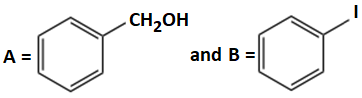
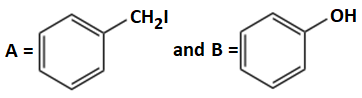
Q4. Consider the following reaction:
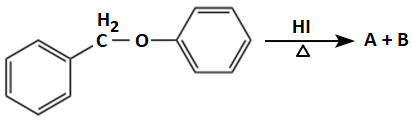
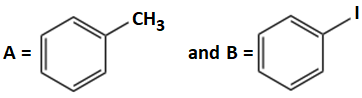
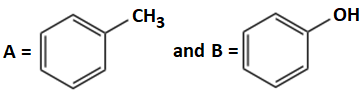
Identify products A and B:
Identify products A and B:


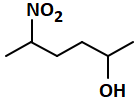
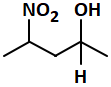
Q5. Which amongst the following will be most readily dehydrated under acidic conditions?
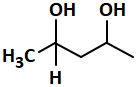
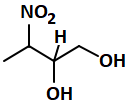

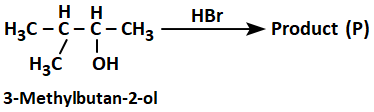
Q6. Consider the following reaction and identify the product (P):
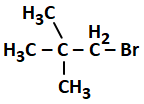
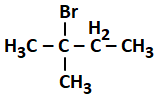
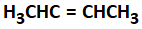
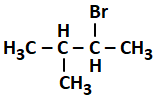

Q7. Identify D in the following sequence of reactions:
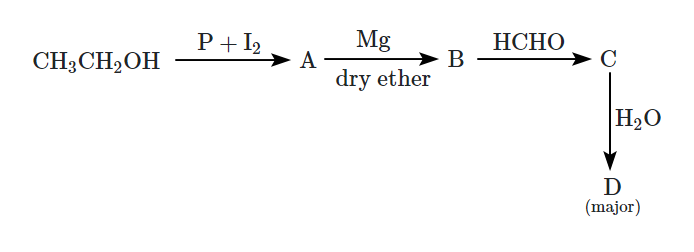
Q8. Which one of the following alcohols reacts instantaneously with Lucas reagent?
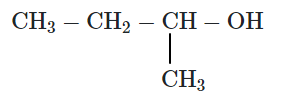
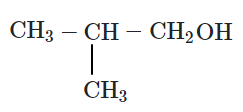
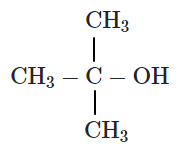
- $\mathrm{CH}_3-\mathrm{CH}_2-\mathrm{CH}_2-\mathrm{CH}_2 \mathrm{OH}$
Q9. Identify the correct reagents that would bring about the following transformation.
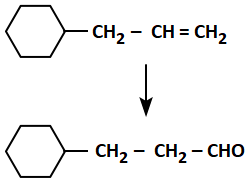

Q10. The total number of possible isomers (both structural as well as stereoisomers)
of cyclic ethers of molecular formula $C_4H_8O$ is :
of cyclic ethers of molecular formula $C_4H_8O$ is :