
Alternating Current
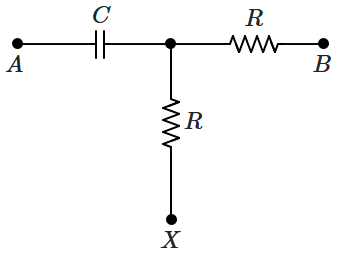
Q1. The end \(‘B’\) of the circuit is earthed \((V_B = 0)\) while a sinusoidal voltage is applied at \(‘A’;\) \(V_{A}=V_{0} \sin \omega t.\) The rms voltage across the capacitor \({C}\) equals that across the upper resistor \({R}\) (as shown in the figure). What is the phase difference between the current through the capacitor and the voltage across the capacitor when no current flows out at \(X?\)
Q2. A step-down transformer connected to an AC mains supply of \(220~\text{V}\) is made to operate at \(11~\text{V},\) \(44~\text{W}\) lamp. Ignoring power losses in the transformer, what is the current in the primary circuit?