Q1. An object placed in front of a concave mirror of a focal length \(15~\text{cm}\) produces a virtual image which is twice the size of the object. The position of the object is:
- \(\text{-}5.5~\text{cm}\)
- \(\text{-}6.5~\text{cm}\)
- \(\text{-}7.5~\text{cm}\)
- \(8.5~\text{cm}\)
Explanation:
Hint: \({m}={-}\frac{v}{u}\)
Step: Find the position of the object.
The magnification of the concave mirror is given by;
\(\Rightarrow {{m}=\frac{{h}_{I}}{{h}_{O}}} \Rightarrow {{m}=\frac{f}{{f}{-}{u}}} =2 \)
\(\Rightarrow {{2}=\frac{{-}{15}}{{-}{15}{-}{u}}} \Rightarrow {{u}={-}{7}{.}{5}~\text{cm}}\)
Hence, option (3) is the correct answer.
Q2. Dispersion of light is caused due to:
- intensity of light
- density of the medium
- wavelength of light
- amplitude of light
Explanation:
Hint: \(n(\lambda)=A+\frac{B}{\lambda^2}\)
Explanation: Dispersion of light is the splitting of white light into its constituent colors due to the surface’s refractive index and the light’s wavelength. If the light entering the prism is with a single color then the emergent beam also has different colors arranged in a definite order.
This happens because different wavelengths of light travel at different speeds in a medium, causing them to refract by different angles.
The primary cause of dispersion is the dependence of refractive index on the wavelength of light.
Therefore, the dispersion takes place due to the wavelength of light.
Hence, option (3) is the correct answer.
Q3.
Given below are two statements:
| Statement I: |
Image formation needs regular reflection and/or refraction. |
| Statement II: |
The variety in colour of objects we see around us is due to the constituent colours of the light incident on them. |
- Statement I is correct but Statement II is incorrect.
- Statement I is incorrect but Statement II is correct.
- Both Statement I and Statement II are correct.
- Both Statement I and Statement II are incorrect.
Explanation:
Hint: Recall the concept of Reflection and refraction of the light.
Explanation:
Statement I: Image formation needs regular reflection and/or refraction.
This statement is correct. Image formation relies on the interaction of light with surfaces. Here’s how:
Regular Reflection: This occurs when parallel rays of light strike a smooth surface and reflect back in a parallel manner. Mirrors are a prime example of regular reflection. This type of reflection allows for clear, focused images.
Refraction: This occurs when light passes from one medium to another (like from air to water or air to glass). The change in speed causes the light to bend, resulting in image formation. This is how lenses in cameras, telescopes, and our own eyes work.
Statement II: The variety in colour of objects we see around us is due to the constituent colours of the light incident on them.
This statement is also correct. The colors we perceive are based on the interaction between light and objects:
White Light: Sunlight or light from a bulb contains all the colors of the rainbow (the visible spectrum).
Selective Absorption: Objects absorb certain colors of light and reflect others. For instance, a red apple absorbs most colors except red, which it reflects back to our eyes.
Pigments: Many objects, especially those we paint or dye, contain pigments that absorb specific colors and reflect others.
Hence, option (3) is the correct answer.
#468806
Exam: NEET – 2024
Q4. The time taken by sunlight to pass through a glass slab of thickness $5~\text{mm}$ and refractive index $1.5$ is:
- $\left(\dfrac{5}{3}\right) \times 10^{-8}~\text{s}$
- $\left(\dfrac{5}{2}\right) \times 10^{-11}~\text{s}$
- $\left(\dfrac{5}{3}\right) \times 10^{-11}~\text{s}$
- $\left(\dfrac{5}{2}\right)\times 10^{-8}~\text{s}$
Explanation:
Hint: μ=cv
Step: Find the time taken by the sunlight to pass through a glass slab.
The time taken by the sunlight to pass through a glass slab is given by;
t=optical path lengthspeed of light
⇒t=μ×Lc=1.5×5×10−33×108=(52)×10−11 s [L=5 mm]
Hence, option (2) is the correct answer.
#456797
Exam: NEET – 2024
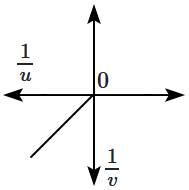
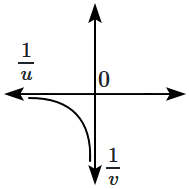
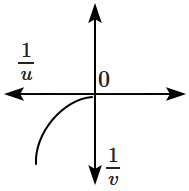
Q5. The graph that shows the correct variation of $\dfrac{1}{v}$ with $\dfrac{1}{u}$ for a concave mirror, where $u$ is the object distance and $v$ is the image distance, is:
Explanation:
Hint: 1v+1u=1f
Step: Find the correct variation of 1v with 1u for a concave mirror.
According to the mirror equation:
1v+1u=1f
⇒1v=−1u+1f ...(1) [f=−ve, for concave mirror]
Equation (1) represents a straight line having a negative slope and negative intercept.
Therefore, the correct graph is shown below;
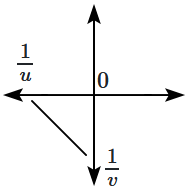
Hence, option (2) is the correct answer.
#456730
Exam: NEET – 2024
Q6. For a prism, when the light undergoes minimum deviation, the relationship between the angle of incidence $(i)$ and the angle of emergence $(i’)$ is:
- $i=i’$
- $i>i’$
- $i<i’$
- $i=0$
Explanation:
Hint: i=e which implies r1=r2.
Step: Find the relation between the angles i and i′.
The angle of incidence i and angle of emergence i′ on the prism is shown in the figure below;
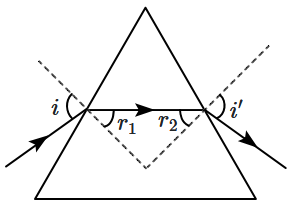
For the minimum angle of deviation;
i=i′
⇒r1=r2
Therefore, the correct relation between the angles is i=i′.
Hence, option (1) is the correct answer.
#456714
Exam: NEET – 2024
Q7. A small telescope has an objective of focal length $140~\text{cm}$ and an eyepiece of focal length $5.0~\text{cm}.$ The magnifying power of the telescope for viewing a distant object is:
Explanation:
Hint: m=f0fe
Step: Find the magnifying power of the telescope for viewing a distant object.
Given: f0=140 cm,fe=5 cm
The magnifying power of a telescope for viewing a distant object is given by;
m=f0fe
⇒m=1405=28
Therefore, the magnifying power of the telescope is 28.
Hence, option (1) is the correct answer.
#454989
Exam: NEET – 2024
Q8. A light ray enters through a right-angled prism at point
$P$ with the angle of incidence
$30^\circ$ as shown in the figure. It travels through the prism parallel to its base
$BC$ and emerges along the face
$AC.$ The refractive index of the prism is:

- ${\dfrac{\sqrt5}{2}}$
- ${\dfrac{\sqrt3}{4}}$
- ${\dfrac{\sqrt3}{2}}$
- ${\dfrac{\sqrt5}{4}}$
Explanation:
Hint: Apply Snell’s law.
Step: Find the refractive index of the prism.
Given: A=90∘
Let the refractive index of the prism is μ.
A=r1+r2
⇒r2=90∘−r1
Apply Snell’s law at point P
1×sin30∘=μsinr1⇒μsinr1=12 ...(1)
Apply Snell’s law at point Q
μ×sinr2=1sin90∘⇒μsinr2=1⇒μsin(90−r1)=1
⇒μcosr1=1 ...(2)
Squaring and adding equations (1) and (2) we get;
μ2=1+14=54
⇒μ=√52
Therefore, the refractive index of the prism is √52.
Hence, option (1) is the correct answer.
#454958
Exam: NEET – 2024
Q9. In a certain camera, a combination of four similar thin convex lenses are arranged axially in contact. Then the power of the combination and the total magnification in comparison to the power $( p )$ and magnification $( m )$ for each lens will be, respectively –
- $4 p$ and $m^4$
- $p^4$ and $m^4$
- $4 p$ and $4 m$
- $p^4$ and $4 m$
Exam: NEET – 2025
Q10. A microscope has an objective of focal length $2~\text{cm},$ eyepiece of focal length $4~\text{cm}$ and the tube length of $40~\text{cm}.$ If the distance of distinct vision of eye is $25~\text{cm},$ the magnification in the microscope is:
Exam: NEET – 2025