Reaction Mechanism – Organic Chemistry
Q1.
The elimination reaction among the following is:
Q2.
Common oxidizing agents used in organic chemistry are;

The elimination reaction among the following is:
When an alkyl halide reacts with the base then an elimination reaction occurs and an alkene is obtained as a product.
The reaction is as follows:
C2H5Br+ KOH(alc.) → C2H4 + KBr+H2O
The mechanism of the reaction is as follows:
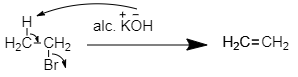
The other reactions are as follows:
CH3CH3+Cl2 → CH3CH2Cl+ HCl ( Free radical substitution reaction)
CH3Cl+ KOH(aq.) → CH3OH +KCl (nucleophilic substitution reaction)
CH2=CH2 +Br2 → CH2BrCH2Br (electrophilic addition reaction)
Common oxidizing agents used in organic chemistry are;
1. Oxidising Reagent = number of oxygen atoms should be more
2. Peroxide or Superoxide bonds.
Fenton’s reagent is a solution of hydrogen peroxide (H2O2) with ferrous iron (typically iron(II) sulfate, FeSO4) as a catalyst that is used to oxidize contaminants or waste waters.
Osmium tetroxide (OsO4) is widely employed as a catalyst in various organic reactions.
The acidified potassium manganate(VII) solution oxidizes the alkene by breaking the carbon-carbon double bond and replacing it with two carbon-oxygen double bonds