Electric Charges and Fields
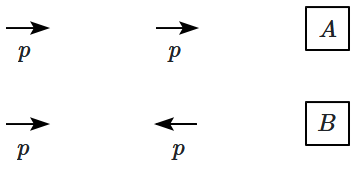
Q1. Two dipoles are placed along the \(x\)-axis, as shown in the figure, in two different configurations: \(A\) and \(B.\) Then, they will:


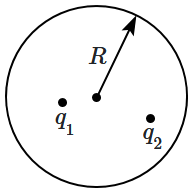
Q2. An uncharged spherical conducting shell of outer radius \(R\) has two point charges \(q_1,q_2\) placed within it. The flux of the electric field due to all charges from the outer surface of the sphere is \(\phi_0\) while the potential of the sphere is \(V_0.\) The ratio \(\dfrac{\phi_0}{V_0}\) is proportional to: