Waves
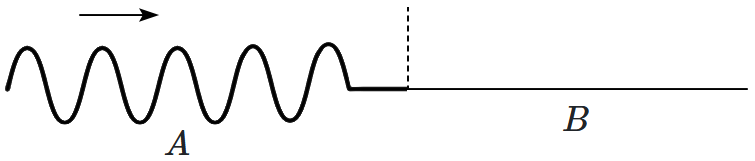
Q1. A taut wire \((A)\) with a tension of \(80~\text N\) is smoothly joined to a second wire \((B)\text:\) wire \(A\) has a mass of \(8~\text{g/m} \) while \(B\) has a mass of \(2~\text{g/m}.\) A mechanical waveform with a wavelength of \(40~\text{cm}\) approaches the joint from the side of wire \(A\) and is transmitted through wire \(B.\) The wavelength of the transmitted wave (on wire \(B\)) is:
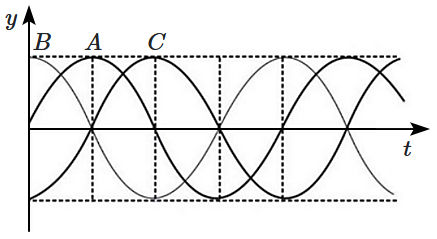
Q2. Three progressive waves \(A,\) \(B\) and \(C\) are shown below. With respect to wave \(A\text{:}\)