
Oscillations

Q1. For the oscillations exhibited by the spring-block system, on a smooth surface (along the springs), the time period is:
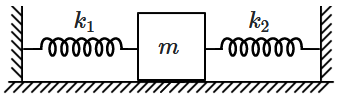
    
 
  • \\(\\begin{aligned} {2}\\mathit{\\pi}\\sqrt{\\dfrac{{m}\\left({{k}_{1}{+}{k}_{2}}\\right)}{{k}_{1}{k}_{2}}} & \\end{aligned}\\)
  • \\(\\begin{aligned}2\\pi\\sqrt{{{m\\left({k_{1}+k_{2}}\\right)}\\over{2k_{1}k_{2}}}} &\\end{aligned}\\)
  • \\(\\begin{aligned} 2\\pi\\sqrt{{{m}\\over{k_{1}+k_{2}}}} & \\end{aligned}\\)
  • \\(\\begin{aligned} \\pi\\sqrt{{{m}\\over{k_{1}+k_{2}}}} & \\end{aligned}\\)
Q2. The kinetic energy \(K\) for a particle executing simple harmonic motion is given by; \(K = K_0 \sin^2(\omega t).\) The maximum value of potential energy is:
  • \\(K_0\\)
  • zero
  • \\(\\dfrac{K_0}{2}\\)
  • \\(\\dfrac{K_0}{4}\\)