Physics

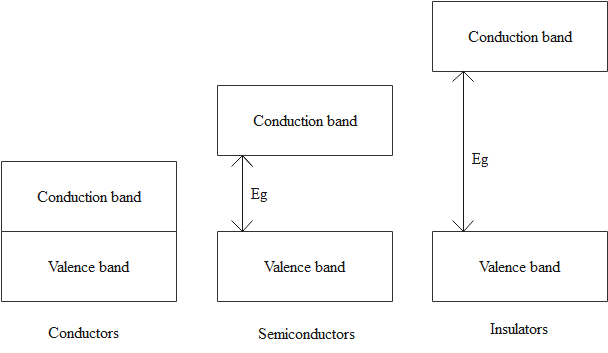
Q21. The forbidden energy band gaps in conductors, semiconductors and insulators are \(EG_{1},\) \(EG_{2}\) and \(EG_{3}\) respectively. The relation among them is:
  • \(EG_{1}=EG_{2}=EG_{3}\)
  • \(EG_{1}<EG_{2}<EG_{3}\)
  • \(EG_{1}>EG_{2}>EG_{3}\)
  • \(EG_{1}<EG_{2}>EG_{3}\)
Q22.

Given below are two statements: 

Assertion (A): Angular momentum of an isolated system of particles is conserved.
Reason (R): The net torque on an isolated system of particles is zero and the rate of change of angular momentum equals the torque.


  • Both(A)and(R)are True and(R)is the correct explanation of(A).
  • Both(A)and(R)are True but(R)is not the correct explanation of(A).
  • (A)is True but(R)is False.
  • (A)is False but(R)is True.
Q23.

A particle moves at a constant speed along the circumference of a circle with a radius \(R,\) subject to a central fictitious force \(F\) that is inversely proportional to \(R^3.\) Its time period of revolution will be given by:

  • \( T \propto R^2 \)
  • \( T \propto R^{\frac{3}{2}} \)
  • \( T \propto R^{\frac{5}{2}} \)
  • \(T \propto R^{\frac{4}{3}} \)
Q24.

In Young’s double-slit experiment, how many minimas can be obtained on a screen, if the wavelength of light used is 2000 Ao and slit width is 0.0008 mm?

  • 6
  • 7
  • 8
  • 9
Q25.

The energy liberated on complete fission of 1 kg of U92235 is (Assume 200 MeV energy is liberated on fission of 1 nucleus) 

(1) 8.2×10¹⁰J                           

(2) 8.2×10⁹J

(3) 8.2×10¹³J                           

(4) 8.2×10¹⁶J

  • (1)
  • (2)
  • (3)
  • (4)
Q26.

A certain mass of hydrogen is changed to helium by the process of fusion. The mass defect in the fusion reaction is 0.02866 u. The energy liberated per nucleon is: (given 1 u = 931 MeV)

  • 67 MeV
  • 26.7 MeV
  • 6.675 MeV
  • 13.35 MeV
Q27.

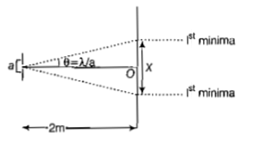
A beam of light of 600 nm from a distant source falls on a single slit 1 mm wide and the resulting diffraction pattern is observed on a screen 2 m away. The distance between first dark fringes on either side of the central bright fringe is
                      

  • 2cm
  • 2mm
  • 4cm
  • 4mm
Q28. A solid metallic sphere is subjected to an external pressure of \(p.\) The bulk modulus of the material of the sphere is \(B.\) The change in the magnitude of the middle cross-sectional area of the sphere \((\Delta A)\) equals: (initial area = \(A\))
  • \(\dfrac{pA}{B}\)
  • \(\dfrac{pA}{3B}\)
  • \(\dfrac{2pA}{3B}\)
  • \(\dfrac{pA}{2B}\)
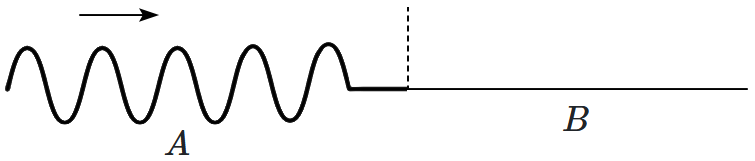
Q29. A taut wire \((A)\) with a tension of \(80~\text N\) is smoothly joined to a second wire \((B)\text:\) wire \(A\) has a mass of \(8~\text{g/m} \) while \(B\) has a mass of \(2~\text{g/m}.\) A mechanical waveform with a wavelength of \(40~\text{cm}\) approaches the joint from the side of wire \(A\) and is transmitted through wire \(B.\) The wavelength of the transmitted wave (on wire \(B\)) is:
  • \(40~\text{cm}\)
  • \(80~\text{cm}\)
  • \(20~\text{cm}\)
  • \(160~\text{cm}\)
Q30. A coil \((A)\) has an inductance \(L_1\) and a resistance \(R_1,\) while a second coil \((B)\) has an inductance \(L_2,\) but no resistance (or negligible resistance). If these two coils are connected in series, the inductance of the combination will be:
  • \(L_1+L_2\)
  • \(L_1\)
  • \(L_2\)
  • \(\sqrt{L_1L_2}\)
1 2 3 4 5 13