Physics
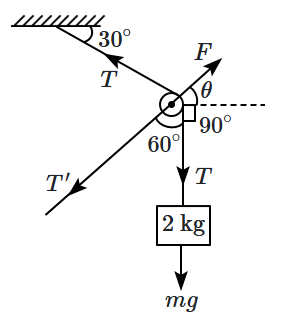
Q11. A light string, attached to the ceiling (see figure), passes over a smooth, light pulley and holds a \(2~\text{kg}\)-block. A force \(F,\) acting at an angle \(\theta\) with the horizontal, has to be applied to the pulley to hold it in place. Take \(g=10~\text{m/s}^2.\)
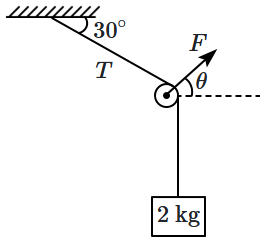
The angle \(\theta\) equals:
The angle \(\theta\) equals:
Q12. Given below are two statements:
| Assertion (A): | Magnetic dipoles, when placed near a long straight current-carrying wire, are deflected perpendicular to the wire. |
| Reason (R): | The magnetic field lines of a straight current-carrying wire are oriented in a direction which is perpendicular to the wire. |
Q13. A piece of soft iron is placed within the coils of a solenoid, the current through the solenoid being sufficiently large so that the iron is completely magnetised. If the current is increased further the magnetic field within the iron will:
Q14. Given below are two statements:
| Assertion (A): | The energy of the photon causing the \(n=2\rightarrow4\) transition in the \(\mathrm{He}^+\text-\)ion is equal to the one causing the \(n=1\rightarrow2\) transition in the \(\mathrm{H}\text-\)atom. |
| Reason (R): | The energy level corresponding to the \(n^{\text{th}}\) quantum number of the \(\mathrm{H}\text-\)atom has the same value as the \(2n^{\text{th}}\) level of the \(\mathrm{He}^{+}\text-\)ion. |
Q15. The magnetic force per unit length acting between two long parallel current carrying wires carrying currents \(i_1,i_2\) and separated by a short distance \(r\) is proportional to:
Q16. In a moving coil galvanometer, if the number of turns in the coil increase by \(25 \text{%},\) the change in voltage sensitivity is:
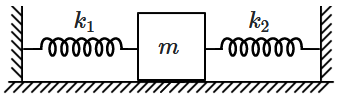
Q17. For the oscillations exhibited by the spring-block system, on a smooth surface (along the springs), the time period is:
Q18. Match the units mentioned in List-I with the units in List-II.
| List-I | List-II | ||
| (a) | H/s | (i) | s2 |
| (b) | H×A | (ii) | Wb |
| (c) | H×F | (iii) | s |
| (d) | \(\Omega\)×F | (iv) | \(\Omega\) |
Q19. Given below are two statements:
| Assertion (A): | The average velocity of the object over an interval of time is either smaller than or equal to the average speed of the object over the same interval. |
| Reason (R): | Displacement is the shortest distance between two points. |
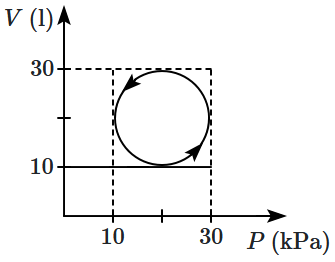
Q20. The heat energy absorbed by a system in going through a cyclic process shown in the figure is: