
NEET Practice Questions
Q231. For a prism, when the light undergoes minimum deviation, the relationship between the angle of incidence $(i)$ and the angle of emergence $(i’)$ is:
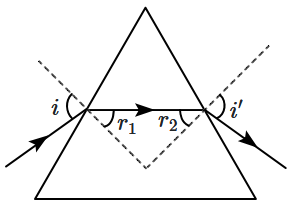
Q232. A small telescope has an objective of focal length $140~\text{cm}$ and an eyepiece of focal length $5.0~\text{cm}.$ The magnifying power of the telescope for viewing a distant object is:
Q233. A light ray enters through a right-angled prism at point $P$ with the angle of incidence $30^\circ$ as shown in the figure. It travels through the prism parallel to its base $BC$ and emerges along the face $AC.$ The refractive index of the prism is:

Q234. In a certain camera, a combination of four similar thin convex lenses are arranged axially in contact. Then the power of the combination and the total magnification in comparison to the power $( p )$ and magnification $( m )$ for each lens will be, respectively –
Q235. A microscope has an objective of focal length $2~\text{cm},$ eyepiece of focal length $4~\text{cm}$ and the tube length of $40~\text{cm}.$ If the distance of distinct vision of eye is $25~\text{cm},$ the magnification in the microscope is:
Q236. A ray of monochromatic light is passing through an equilateral prism $(ABC)$ as shown in the figure. The refracted ray $(QR)$ is parallel to its base $(BC)$ and the angle of incidence $(i)$ is $50^\circ$ . Then the angle of deviation $(\delta)$ is:

Q237. In a concave lens, a ray of light emanating from the object parallel to the principal axis of the lens, after refraction: