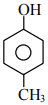
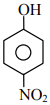
The correct acidic order of the following is:
 |
 |
 |
| (I) | (II) | (III) |
- I > II > III
- III > I > II
- II > III > I
- I > III > II
Hint: Phenol acidity increases if it contains an electron-withdrawing group and phenol acidity decreases if it contains an electron-donating group at para or ortho position.
Explanation:
The acidic behaviour of phenols may be explained on the basis of two reasons:
(i) The value of the dissociation constant of phenols (Ka= 10-10) and alcohols (Ka 10-6 to 10-18).
(ii) Due to resonance (which is not possible in alcohols),
the oxygen atom of the -OH group acquires a positive charge which helps in the release of a proton.

In the dissociation of phenol to phenoxide ion and a proton, the equilibrium lies mainly towards the right hand side as the resulting phenoxide ion is more stable than phenol.
Ar-OH ⇌ArO– + H+

The acidic strength of phenols depends on the nature of substituents present in the benzene nucleus.
Electron withdrawing groups like -NO2, -CN, -CHO and -COOH etc, when present at the ortho and para-positions, with respect to a phenolic group, increase the acidity of phenol due to greater stabilisation of phenoxide ion.
While the presence of electron releasing groups like -NH2, -CH3 etc, decrease the acidity of phenols. This explains the following order of acidity:
p-nitrophenol>phenol>p-cresol.